21.10.2026.
Landing at ZAD after midnight? How flight monitoring, meet and greet, waiting time and fixed prices work on a late-night Zadar Airport transfer.
Your flight lands at Zadar Airport at 23:40 — or 01:15, after a delay nobody mentioned until you were already at the gate. The last bus has gone, the island ferries will not run again until morning, and the taxi rank outside a small seasonal terminal is not a safe bet for your first night in Croatia.
The real question is not whether a taxi exists at ZAD at midnight, but whether the car you booked will still be there and who absorbs the cost if your flight slips. This article walks through a late arrival from touchdown to hotel reception: how flight monitoring works, what meet and greet looks like in this terminal, how waiting time and night rates are treated, and what to send the operator in advance so the pickup does not depend on luck.
Why Zadar Airport behaves differently after dark
ZAD is a compact, strongly seasonal airport. In summer it handles a dense schedule of late landings from across Europe; in winter the terminal can be quiet within half an hour of a single arrival. That rhythm shapes everything that happens after passport control.
Public transport is built around daytime movement. Buses into Zadar town and onward to the main bus station run to a timetable that thins out in the evening, and nothing on it connects to the islands. Ferries to Ugljan, Dugi Otok and the wider archipelago keep their own schedule and do not wait for a delayed flight.
What is left after midnight is the road: a rental car collected and driven while tired, a taxi whose availability depends on how many other flights landed at the same time, or a pre-booked private transfer where the driver already has your flight number and your destination.
If you land at Split Airport instead
Split receives far more late-night traffic and its terminal stays busier for longer, but the same logic applies. The last buses and catamaran connections go in the evening, and the drive north towards Zadar or inland to the parks is long enough that a tired arrival is a poor time to improvise. Whether you need an onward crossing or a road transfer, check the timetables first — this guide to Split Ferry Port transfers and schedules covers how the connections fit together.
How flight monitoring works for a late-night transfer
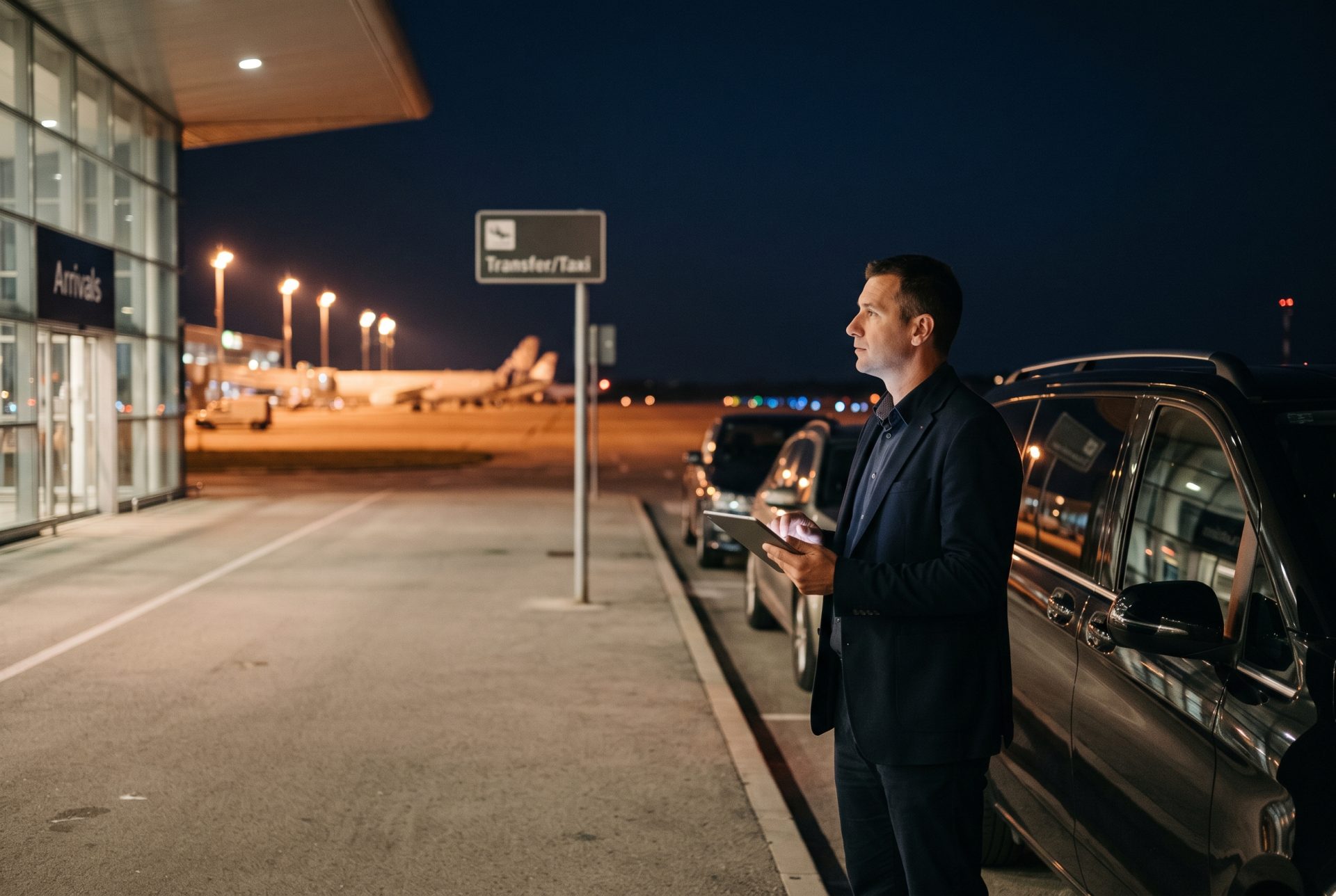
Flight monitoring means the operator works from your flight number rather than the arrival time printed on your confirmation. The scheduled time is only the starting point; the aircraft's actual progress is what determines when a driver leaves for the terminal.
When the flight is delayed
A delay is the ordinary case, not an exception. A monitored flight pushes the pickup back automatically, so the driver is dispatched against the new landing time instead of circling the car park or counting waiting time from the original hour.
The practical detail for you: you do not need to call from the departure airport. You do need a mobile number that works abroad, and ideally a messaging app the operator can reach you on at short notice.
Diversions, cancellations and missed connections
If the flight diverts to Split or is cancelled outright, the transfer cannot run as booked, and the question becomes rebooking rather than waiting. Message the operator as soon as you know. A diversion turns a short Zadar hop into a two-hour-plus road journey, which is worth understanding before you agree to a replacement at the arrivals desk.
Meet and greet at Zadar Airport: what it actually involves
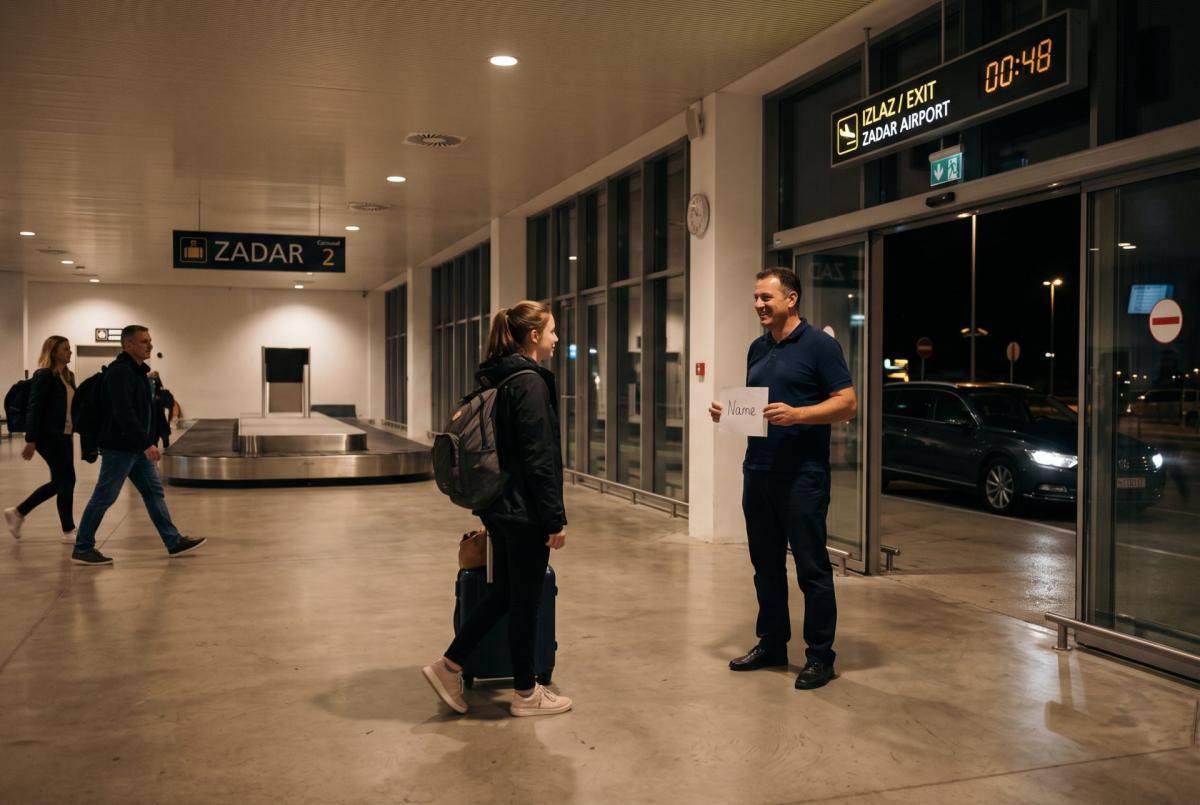
At a terminal this size, meet and greet is straightforward. The driver waits in the arrivals hall with your name, usually after checking the arrivals screen against your flight, and walks you to the car. There is no shuttle bus, no desk queue and no second transaction at the counter.
- The driver needs your flight number so that the arrivals board and the tracking feed agree.
- Your name on a sign, or a message with the meeting point and the driver's number, removes the guesswork in a hall with two exits.
- Luggage goes with you; there is no separate handling step and nothing to renegotiate once you are standing at the car.
If your luggage is delayed
Late at night, a delayed bag is the most common reason a pickup runs long. A driver on a meet and greet will normally hold for a reasonable period, and the sensible arrangement is to agree waiting terms at booking rather than debate them at 01:00. Tell the driver as soon as the belt stops producing luggage — a message is faster than a conversation through glass doors.
If you travel with hold luggage only, build a little slack into your plan. Being the last bag on the belt after the last flight is a specific and unglamorous kind of delay.
Fixed price, night rate and waiting time

A private transfer is priced by route, not by the clock, so a landing at 00:40 normally costs the same as the same route at midday unless the operator applies a defined night tariff — and that should be visible before you confirm. A metered taxi is the opposite: the metre starts when you get in, and the fare depends on traffic, route and any night supplement.
| Option | Booked before you land | Price known in advance | Availability after midnight | Luggage | Door to door |
|---|---|---|---|---|---|
| Private transfer | Yes | Yes, fixed per route | Guaranteed by the booking | Matched to the vehicle you booked | Yes, to the address |
| Taxi from the rank | No | No, metered or negotiated | Depends on the night | Depends on what turns up | Yes |
| Public bus | No | Yes, per ticket | Usually no | Your responsibility | No, fixed stops |
The trade-off is clear: a private transfer costs more than a bus ticket and generally more than a rank taxi's best case, but it removes the two things that hurt at one in the morning — uncertainty about whether a car exists, and uncertainty about the final price.
What to send when you book a late-night transfer
- Flight number and route, not just the landing time.
- Arrival airport, since ZAD and Split feed the same coast and the drive times differ sharply.
- Number of passengers and check-in luggage, plus any oversized items.
- Child seats and the children's ages if you are travelling as a family.
- The full accommodation address, including hotel name, street and any gate or reception detail.
- A mobile number that works abroad, and a messaging app if you use one.
With the route settled and the price fixed, the booking itself takes a minute — you can request a quote for a late-night Zadar Airport transfer using those details and weigh it against the alternatives before you commit.
Festival season: late arrivals into Zrće, Novalja and Tisno
Between June and September, a large share of late-night ZAD arrivals are not going to a hotel in Zadar at all. They are heading for Zrće beach outside Novalja, for Tisno, or for festival accommodation along the coast. On those nights demand spikes, the taxi rank empties quickly, and the drive is longer than most visitors expect.
The run to Zrće is a substantial coastal drive rather than a quick hop, and Tisno is shorter but still not a stroll. If you land on a festival night, book ahead and treat the drive as part of the trip — the Zadar Airport to Zrće Beach route sets out what the journey involves.
Common mistakes on a late arrival at ZAD
- Booking on the scheduled landing time only. Without a flight number the driver has nothing to track and no reason to adjust.
- Assuming the rank will have cars. At a small seasonal airport, supply follows the arrivals board; if three flights land together and you are last out, you wait.
- Leaving the luggage question until you reach the car. Four large cases and a small hatchback is a problem that cannot be solved in the pick-up lane.
- Not checking what waiting time costs. A generous free window and a strict one look identical in a confirmation email until you read that line.
- Booking a ferry for the same night. Nothing after midnight connects ZAD to the islands; the first crossing is a morning matter.
The short version
After midnight at Zadar Airport, the reliable pattern is a ride booked against your flight number, priced per route, with a driver waiting in arrivals and a stated waiting allowance if your bag is slow. That combination turns a 01:00 landing into an ordinary car journey instead of a negotiation.
Everything else — the bus timetable, the ferry schedule, the rank taxi — assumes your flight arrived when it said it would. Late arrivals, delays and slow baggage are exactly the cases where that assumption fails.